
The Algorithm Thinks You’re Ugly
My Observer Interview with Artist Gretchen Andrew on her ‘Universal Beauty’ series, which exposes how A.I. collapses global beauty into a single, impossible face—and what humanity loses as a result

Originally published in Observer Arts on Nov 19
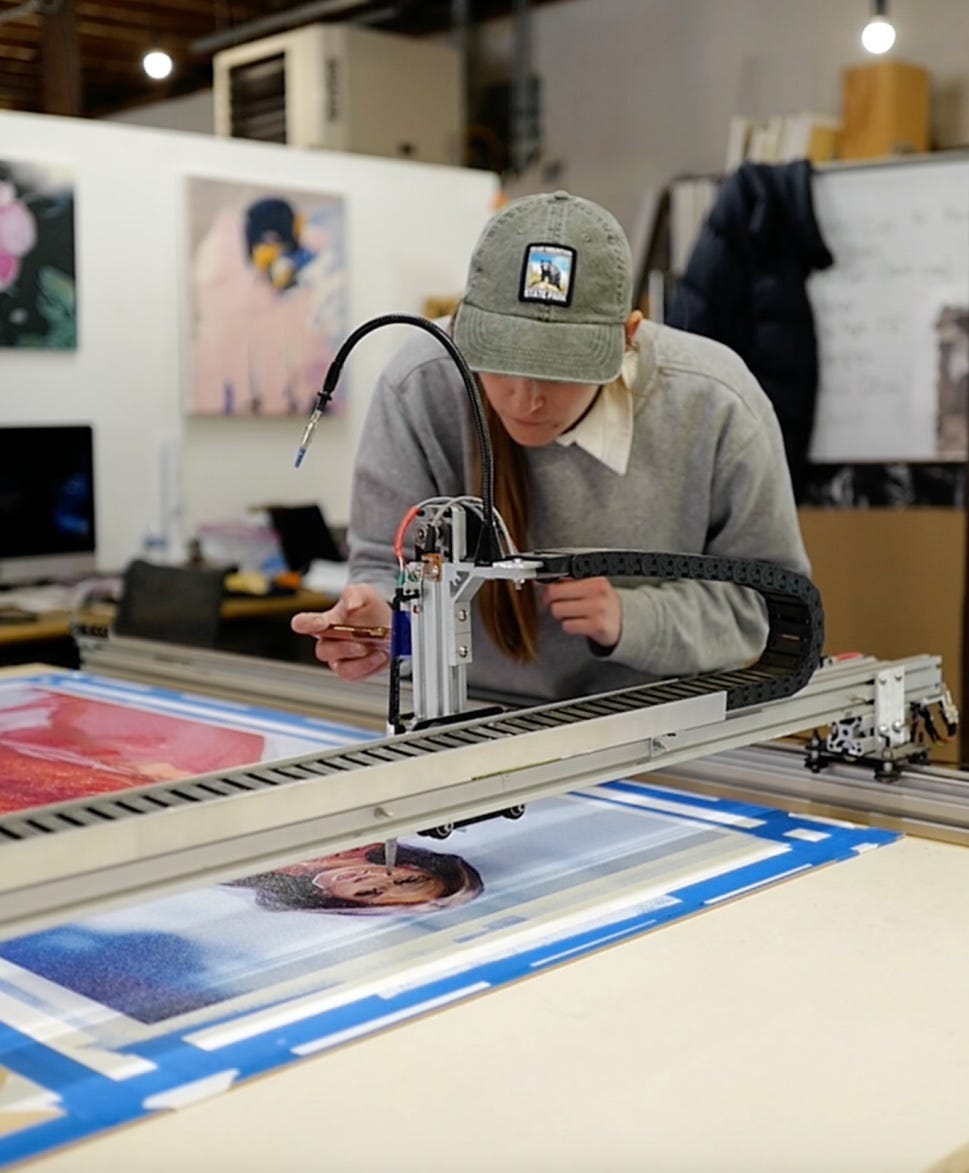
There is a direct line between lip fillers and the techno-apocalypse, and Gretchen Andrew draws that line with her latest Universal Beauty series. This series, recently acquired by the Whitney in New York, reveals the preferences of hidden algorithms that define our current beauty standards. Standards not even Miss Universe contestants can meet. In our conversation, Andrew and I discuss how impossible-to-achieve criteria are flattening people’s relationship to their bodies and homogenizing faces around the globe. What is at stake? “The whole diversity of humanity is lost,” according to the artist.
Gretchen, an ex-Googler, is a Silicon Valley dropout. After becoming disillusioned by the way technology was designed to exploit users and experiencing a culture that penalized her for dressing like Cher from Clueless, Gretchen left tech to pursue a career in art. In the art world, she felt free to use technology subversively and wear short skirts as a form of 3.0 feminism. Her previous projects: Thirst Trap Glitch Gifs, in which she used SEO optimization hacks to make her vision board canvases the top search result for “contemporary art auction record,” capture the artist’s drive perfectly.
Gretchen could have continued further along this line, using her brilliance to expose technological loopholes while promoting her name. However, Universal Beauty marks a departure. Or perhaps an evolution or maturing. Not in Gretchen’s interests, but in her tactics. The focus is less about her explicitly and more about the technology that traps us all. Making us feel forever inadequate. Forever ugly. While keeping us craving more of this feeling. And Gretchen will be the first to admit that she is not above social media addiction. But admission, be it via her work or her words, is always the first step.
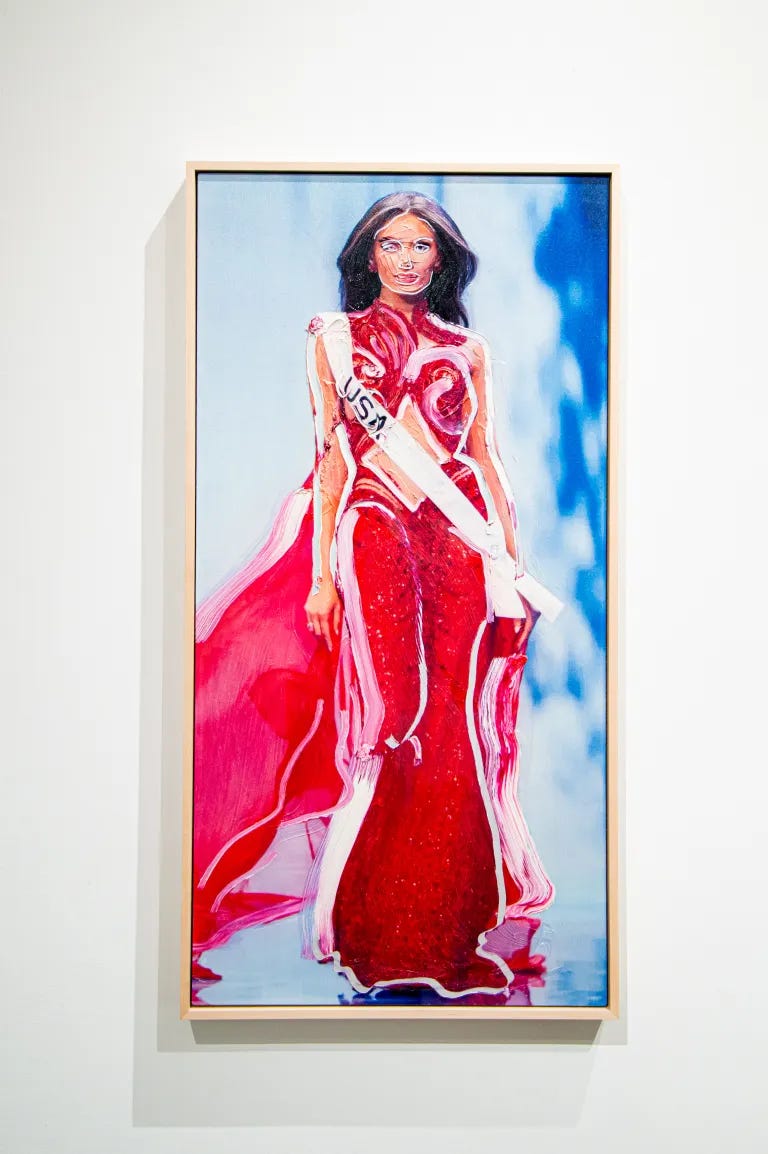
MM: First, congratulations on your acquisition by the Whitney. What can you tell us about the Facetune Portraits project, and about the work that was acquired?
GA: In Facetune Portraits, I look at how A.I.-driven beauty standards are impacting how we experience ourselves and how we experience others. I take what is normally an invisible force—whether it’s digital Facetuning or the way it’s impacting things like lip fillers and plastic surgery—and make it visible so that we can talk about it. In my Universal Beauty series, I look at Miss Universe contestants who are from all over the world—they’re completely gorgeous—and yet they’re not good enough for the algorithms, giving the rest of us absolutely no hope. Not only that, but the contestants are from all around the world. They should look completely different, but we see the homogenizing impact of A.I. when we see Miss Jamaica being given the same body as Miss Finland being given the same body as Miss Philippines. It’s compressing all humanity into a single unified look.
Describe the Facetune aesthetic. What does the algorithm think is beautiful?
We’ve grown so used to seeing each other and ourselves on a two-dimensional screen. And because screens are flat, our expectations of how we’re supposed to look are incorporating efforts to mimic that third dimension within the two-dimensional space of the screen. One example is having absurdly big lips. Some people really like the way that those big lips look from the front, but no one thinks that they look great from the side. That’s why we get memes around “duck lip.” There’s this distinct prioritization of making sure we look good on a screen. It reminds me of ancient Egyptian art. The reason why hieroglyphics have bodies that are contorted is that, within the two-dimensional surface, the Egyptians wanted to convey the three-dimensionality of the body. So they represented each body part from its most recognizable angle and sort of stuck it all together. That’s really what’s happening today with our cameras and algorithms: we are attempting to convey three dimensions in the 2D space of a screen.
What is lost when we do that?
The whole diversity of humanity is lost. There have always been beauty standards, but never before has there been a single, universal, international beauty standard. We’re also losing connections to our actual bodies. We’re prioritizing how people look over what they do. We’re prioritizing how we look over how we feel. Within that prioritization, we lose a really important connection to ourselves. Another thing we’re losing is the celebration of the individual. I see not just a desire to be beautiful, but a desire to be like everyone else. That feels safer to people today than to actually look like yourself.
…
This is fantastic.
Great conversation.